Key Points
- Owens Corning missed third-quarter revenue and earnings estimates, and weak fourth-quarter guidance reflects a struggling housing market rather than company-specific issues.
- Weak housing data, including falling builder confidence and declining single-family permits, combined with soft roofing demand from below-average storm activity, pressured the roofing segment's sales and profits.
- Despite a bearish technical outlook, Owens Corning's strong free cash flow provides substantial coverage for its dividend.
- Special Report: Earn $4,500 a month? Your income may count for more
Owens Corning (NYSE: OC) is an unlikely candidate to benefit from the flight to safety in the market. Shares of OC are down over 25% in the last three months, and the company's third-quarter earnings report didn't help the bull case.
The company missed on the top and bottom lines. The $2.49 billion in net sales was down 7% year over year (YOY). Sales also fell short of the $2.62 billion analysts expected. The story was worse on the bottom line. Adjusted earnings per share (EPS) of $2.44 were 33% lower YOY and well below the $3.06 consensus estimate.
Guidance offered little relief. Management expects fourth-quarter revenue of $2 billion to $2.2 billion. It sees adjusted EBITDA margin falling to 10% to 12%. That compares with 20% in Q3 and 17% in the fourth quarter of 2025. The company also declined to give a 2027 forecast, saying results will depend heavily on market conditions.
A Weak Housing Market Remains in Focus
Amid the ongoing drama in the technology sector, investors received dismal news from the housing sector this week. None of it was bullish for investors hoping for a turnaround in Owens Corning stock.
-
On Nov. 17, the National Association of Home Builders (NAHB), in conjunction with Wells Fargo, released its Housing Market Index. Builder confidence fell four points to 25, the lowest reading since April 2012. Also, 46% of builders cut prices, and 68% of builders used sales incentives. Both percentages were the highest since the COVID-19 pandemic.
-
On Nov. 18, data showed that housing starts increased 9.9% in October. However, most of that gain came from apartments, as multifamily starts jumped 25.5%. Meanwhile, single-family permits fell 8.7% to their weakest level since January 2023. Building permits are a forward-looking indicator that suggests demand could remain weak into 2027.
-
Also on Nov. 18, investors got the reading on weekly mortgage applications, which fell 2.3% for the week ending Nov. 13. Purchase applications fell 3% on the week and were down 18% YOY. The average contract rate for a 30-year fixed mortgage rose to 7.35%, a three-week high.
Each of these data points aligns with the Owens Corning 10-Q, in which it put "levels of residential and non-residential construction activity" as the lead item on its list of risks to forward guidance. The data undercuts the idea of a quick rebound.
A more optimistic read is that the data supports the view that OC’s Q4 guidance reflects the market, not company-specific problems.
The Roof Business Is Leaking
In the company's Q3 earnings report, Owens Corning reported that its Roofing business maintained a 29% EBITDA margin. Roofing sales fell 16% YOY to $1.04 billion. Segment EBITDA dropped $124 million to $299 million. The company noted that its roofing distributors are expected to continue destocking after a second consecutive year of below-average storm activity.
The weak housing market is a piece of that story. Another factor to consider is a storm season that was weaker than forecasts for the second consecutive year. While that's good news for homeowners, it's a headwind for a company that relies on that demand.
Rising costs add to the pressure. Management expects inflation to cost more than $100 million YOY in Q4, similar to Q3. Executives noted that inflation and improving demand have historically set up a spring roofing price increase. However, they did not announce one.
The Death Cross Is Real, But Support Has Been Strong
The OC chart confirmed a death cross signal when the 50-day simple moving average (SMA) crossed underneath the 200-day SMA around Oct. 26. This is generally considered a bearish indicator, and it's more relevant for Owens Corning, which continues to fall after its earnings report.
However, as of Nov. 19, the stock is near a level that has acted as support several times in 2026. A break below this level would put a stock price of around $100 in play. If the market is in a broad correction, as some analysts believe, then that's a real possibility.
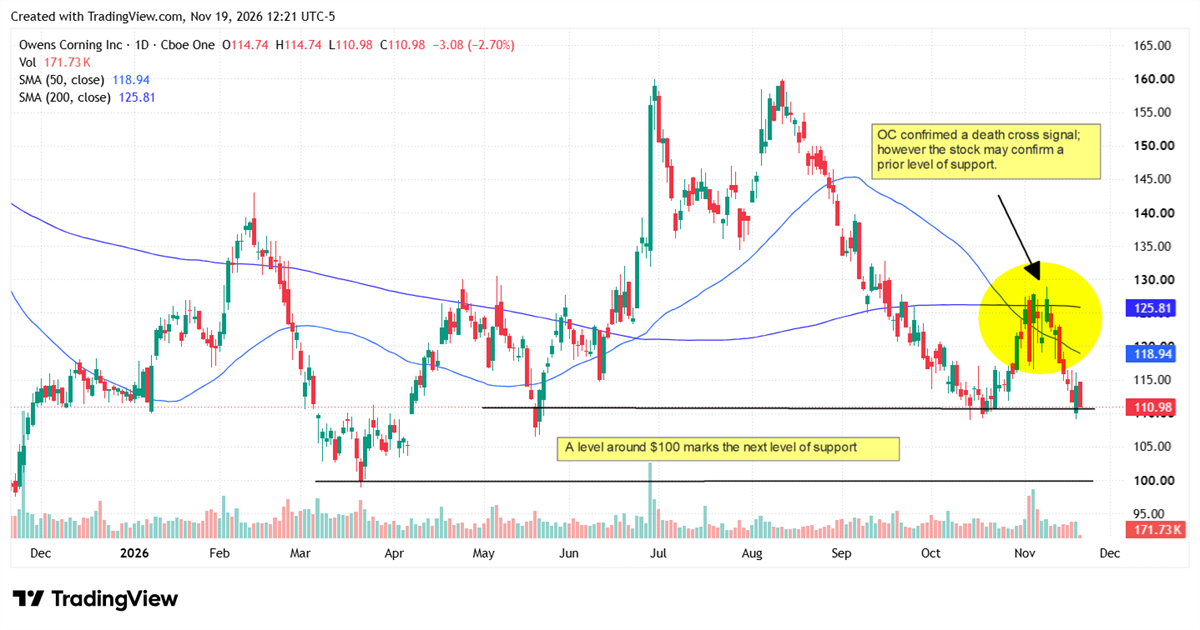
That's not inconsistent with analysts who have a consensus Hold rating on OC. However, that rating comes with a consensus price target around $140, an increase of approximately 25% per share from its Nov. 19 price.
The Dividend Looks Well Covered
Owens Corning pays a quarterly dividend of 79 cents per share, or $3.16 annually.
That costs roughly $62 million per quarter. In Q3, the company generated $622 million in free cash flow, about 10 times that amount. It also paid down $299 million in debt and kept net leverage at 2.5 times.
There is one tradeoff. The company is prioritizing debt reduction and now expects to finish the rest of its $2 billion shareholder-return commitment in 2027.
That means buybacks may take a back seat for now.
Weather changes, and as difficult as it may be to see, the housing market will as well. The bull case for Owens Corning will have to wait until then.
For now, the company's cost discipline should be sufficient to sustain its dividend, which may be enough for income investors in this flight to safety.
Read this article online ›

The best investment opportunities don't wait. Get our research and stock ideas delivered straight to your smartphone—so you never miss a market-moving opportunity. Our text alerts ensure you see timely stock ideas and professional research reports instantly, whether you're in a meeting, commuting, or away from your desk.
Get Text Alerts from American Market News (free)




Comments
Post a Comment