
Key Points
- Applied Materials delivered record quarterly revenue of $9.12 billion, including the highest sequential revenue growth in company history.
- Applied Materials guided fourth-quarter revenue and adjusted EPS above Wall Street expectations, while its gross-margin outlook remained flat sequentially.
- Applied Materials is investing to double quarterly system output by 2028 as customers provide longer-term demand forecasts tied to AI chip capacity.
- Special Report: These gold assets are priced for $1,800 gold [it's over $4,000]
Shares of Applied Materials Inc. (NASDAQ: AMAT) sold off after its Q3 earnings report, despite the largest quarter-over-quarter revenue gain in company history. In fact, the company shredded analysts’ top- and bottom-line estimates, announced guidance above consensus, and stepped up nearly every major 2026 outlook. And then the stock dropped 6% after hours. Why the drop into such a large beat? Expectations are high for a company like Applied Materials, even after a 10% pullback in the last few weeks. Any potential red flag is immediately noticeable, and in this case, it's the gross margin line that stands out like an NFL lineman at the grocery store checkout.
Applied Materials Exceeds Consensus Targets, But Sequential Growth Slows
Back in May, Applied Materials made an audacious guidance call during its fiscal Q2 2026 report. After reporting record quarterly revenue of $7.91 billion, earnings per share (EPS) of $2.86, and a 25-year high in gross margins at 50%, management raised Q3 revenue guidance to $8.95 billion. It also projected more than 30% year-over-year (YOY) growth in its semiconductor equipment business in calendar year 2026. How did these bold projections come to pass?
The company's fiscal Q3 2026 report was released post-market on Aug. 13, and Applied Materials surpassed analysts’ consensus (plus its own projections) with $9.12 billion in revenue. The non-GAAP $3.50 EPS figure also surpassed analysts’ estimates of $3.40, and represented year-over-year (YOY) growth of nearly 30%. Semiconductor Systems accounted for $7.0 billion of the $9.12 billion in revenue, up 27% YOY with a 55.4% gross margin. Management’s Q4 revenue guidance estimates ranged from $9.75 billion to $10.75 billion, with an EPS range of $3.82 to $4.22. It also projects Semiconductor Systems to exceed its previous “greater than 30%” forecast in fiscal 2026, with $7.9 billion in projected Q4 revenue, and continued growth into fiscal 2027.
The midpoint of both ranges came in above market consensus, but these projected sequential growth rates are “just” 11% and 12%, respectively, lower than the results achieved in the most current quarter. Getting dinged for double-digit revenue and EPS projections at the midpoint is a rare sight, but expectations are sky high for a pricey tech stock up more than 100% year-to-date (YTD) and currently trading at 50 times earnings and nearly 15 times sales. Ignore the data showing these numbers growing 51% and 85% YOY; the company faced heavy export restrictions in Q4 2025 that depressed quarterly figures.
Gross Margin Projected to Stall With Operating Margin Picking Up the Slack
Management guided non-GAAP gross margins to 50.4% in Q4 2026, up more than 200 basis points YTD but sequentially flat. Operating expenses are expected to grow to $1.58 billion in Q4 as the company staffs up to meet its goal of doubling quarterly system output by 2028. The company announced six new products in the quarter and also opened its new $500 million Singapore campus.
Projected revenue of $10.25 billion (midpoint) in Q4 on gross margins of 50.4% comes to approximately $5.17 billion in gross profit. Subtract $1.58 billion in operating expenses, and the implied operating margin for Q4 comes in at 35%, which is 100 basis points higher than Q3’s operating margin of 34%. Operating margin is expected to carry the water in Q4 while gross margin stalls, and that’s a much different expansion story than the one that powered the stock to a 180% gain over the last 12 months. The market viewed operating-leverage growth as a weaker driver, adding to the stock’s sell-off.
Bearish Signals Emerge on Chart Post-Earnings
The earnings call reaction drove the stock down only slightly, but it did trigger some worrisome signals on the daily chart. A bearish Death Cross had already formed in July as the stock fell more than 10% from its June all-time high. An attempted rebound was stalled by resistance at the 200-day moving average, which held firm until the Q3 2026 numbers were released. Now the stock has taken out the 50-day moving average in the post-earnings drop, which has also driven the Relative Strength Index (RSI) below the bullish threshold of 50.
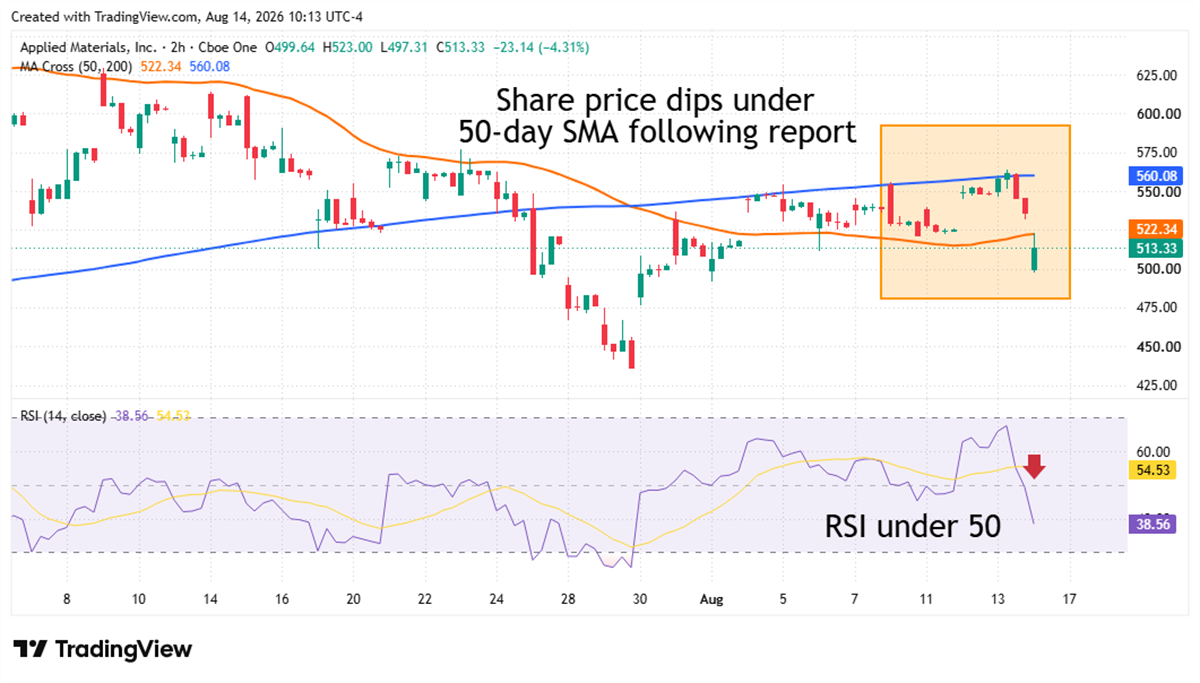
Applied Materials’ gross margin pause may be temporary as the company gears up for the next wave of AI expansion. It certainly isn’t acting like a company that foresees a slowdown, with a backlog stretching out eight quarters and 10 new fab projects announced in Q3 alone. The company’s record performance is likely to continue through 2026, but the market may keep waiting for that margin inflection point before sending AMAT shares on another parabolic run.
Read this article online ›

The best investment opportunities don't wait. Get our research and stock ideas delivered straight to your smartphone—so you never miss a market-moving opportunity. Our text alerts ensure you see timely stock ideas and professional research reports instantly, whether you're in a meeting, commuting, or away from your desk.
Get Text Alerts from American Market News (free)



Comments
Post a Comment