Microsoft Corp. (NASDAQ: MSFT) continues to trade near its 52-week low and is one of the worst-performing Magnificent Seven stocks (which are a lot less magnificent in 2026). One reason for the sour sentiment in Microsoft has to do with Copilot, the company’s artificial intelligence AI tool that integrates with its Microsoft 365 software and productivity suite.
In Microsoft’s Q2 2026 fiscal year earnings report, it cited 15 million paid Microsoft 365 Copilot seats. That’s the first time the company gave a paid-seat number for Copilot. It left analysts and investors wanting more.
At $30 per user per month, 15 million seats are significant. But it’s tiny compared to the revenue Microsoft generates from products like Azure and its massive installed user base.
However, this is where the debate around Copilot starts to feel detached from the overall business. It’s like a food critic going into a pizza parlor and critiquing the hamburger. Copilot is being treated as if it's the primary revenue driver in the company’s business model when the more accurate positioning is as a nice-to-have, albeit premium, add-on.
Expectations Versus Adoption
The issue with Copilot comes down to framing. Investors have treated Copilot adoption as if it were a referendum on Microsoft’s entire AI future. However, that’s a much bigger leap than the business itself has justified so far.
Microsoft is still Microsoft: a platform company with a deep enterprise moat, massive recurring revenue, and an enviable distribution advantage among software companies. Copilot may ultimately become an important monetization layer, but it does not need to become the dominant revenue driver for the investment case to remain strong.
That is why the debate can feel disconnected from the actual business. Investors are looking for Copilot to deliver a fast, visible payoff, but Microsoft’s model usually works on a slower timeline.
Microsoft has built its empire by turning distribution into durability, and Copilot fits that same pattern. It’s being embedded into products customers already use, which means the upside may show up in retention, pricing power, and broader usage across Microsoft’s ecosystem rather than in a dramatic standalone revenue figure.
That matters because AI does not have to produce an instant spike to be valuable. In Microsoft’s case, the more important question is whether Copilot makes Microsoft 365 stickier, deepens enterprise relationships, and strengthens the case for larger cloud commitments.
Those effects may be incremental in the short term, but they can compound over time. The market often wants a clean narrative and a clean number. Microsoft is offering something more subtle: a feature that can improve the economics of an already elite business.
Is Copilot Worth a 36% Drop in Market Cap?
Since the sell-off in MSFT started in October 2025, the company’s market cap has dropped by approximately 36%. Not all of that has to do with the Copilot data. There’s also significant concern about the amount of capital expenditures (CapEx) required to build out the company’s data center needs.
For that matter, there are questions about the legitimacy of those data center needs. More importantly, investors wonder when they will start seeing a return on those billions of dollars in the company’s financials.
However, since Microsoft’s earnings report, when it reiterated its capex spending plans, Copilot has become the story many investors are focused on, perhaps to their own detriment.
Microsoft may not need Copilot to become a blockbuster for the stock to work, but investors keep holding it to that standard. The company is still a fundamentally strong platform business—Copilot just isn't the whole story yet.
MSFT Stock Offers Real Value
In early April, MSFT is trading for around 28x forward earnings. That’s just a tick above the average price-to-earnings for the S&P 500. In other words, far below the premium normally afforded to technology stocks like Microsoft.
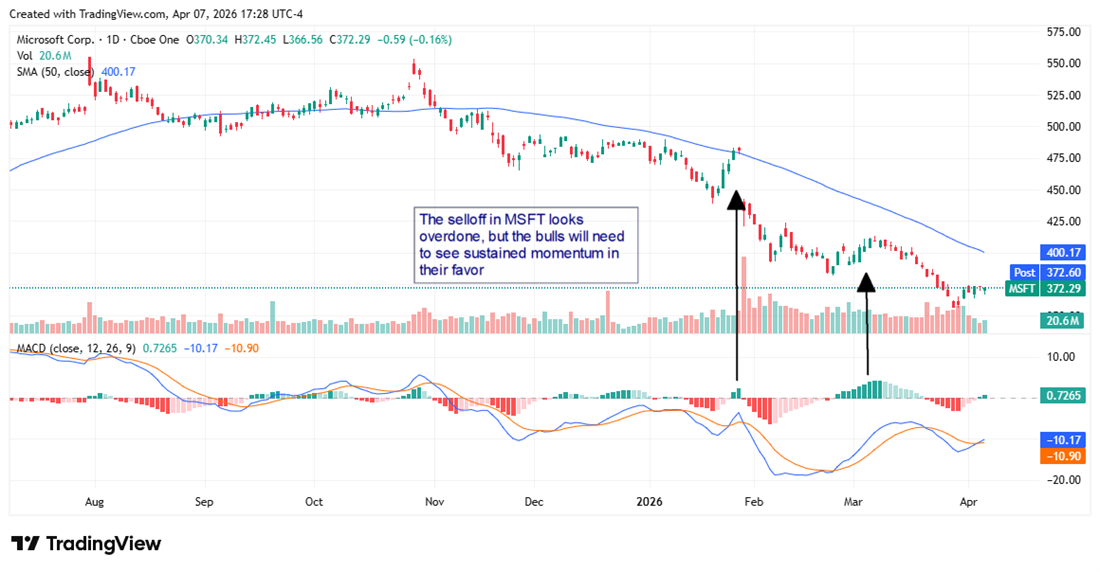
That's where investors have to pay attention to what analysts really believe about MSFT, and that’s a pretty bullish case. The consensus price target of $588.97 is almost 60% above the stock’s price as of this writing. It’s being dragged down by a couple of low price targets, but 40 of 45 analysts rate MSFT a Buy.
All that may be missing is volume to give the stock momentum. That’s not likely to come until Microsoft reports earnings in late April. But if the geopolitical situation clears up and allows investors to focus on earnings, MSFT is sure to be a target for growth-hungry investors seeking companies with upside potential.
Read this article online ›
The best investment opportunities don't wait. Get our research and stock ideas delivered straight to your smartphone—so you never miss a market-moving opportunity. Our text alerts ensure you see timely stock ideas and professional research reports instantly, whether you're in a meeting, commuting, or away from your desk.
Get Text Alerts from American Market News (free)


Comments
Post a Comment