 FuelCell Energy's fiscal Q1 2026 revenue surged 61% YOY but missed consensus by 25%. Heavy dilution and distant profitability weigh on FCEL... ͏ ͏ ͏ ͏ ͏ ͏ ͏ ͏ ͏ ͏ ͏ ͏ ͏ ͏ ͏ ͏ ͏ ͏ ͏ ͏ ͏ ͏ ͏ ͏ ͏ ͏ ͏ ͏ ͏ ͏ ͏ ͏ ͏ ͏ ͏ ͏ ͏ ͏ ͏ ͏ ͏ ͏ ͏ ͏ ͏ ͏ ͏ ͏ ͏ ͏ ͏ ͏ ͏ ͏ ͏ ͏ ͏ ͏ ͏ ͏ ͏ ͏ ͏ ͏ ͏ ͏ ͏ ͏ ͏ ͏ ͏ ͏ ͏ ͏ ͏ ͏ ͏ ͏ ͏ ͏ ͏ ͏ ͏ ͏ ͏ ͏ ͏ ͏ ͏ ͏ ͏ ͏ ͏ ͏ ͏ ͏ ͏ ͏ ͏ ͏ |
| | Written by Thomas Hughes 
FuelCell Energy (NASDAQ: FCEL) has potentially game-changing technology for co-located energy, but it has yet to prove its leadership position. If anything, its results reflect the industry's hurdles, which include high costs, inefficiency relative to other power generation techniques, and the fact that hydrogen isn't exactly green. Based on the latest estimates, truly green hydrogen production accounts for less than 2% of global capacity, although it is growing. Among the takeaways for investors is that FuelCell Energy burns many things, including cash, and the burn will go on and on for many years. FuelCell Burns Cash Better Than Anything Else Highlights from the Q1 2026 release include improvements to the balance sheet. The company improved its cash position and assets, and managed its liabilities, leaving it in a healthy position this year. The caveat is that the incremental, 5% year-to-date equity improvement comes at a cost, and it was dear. The company is using equity sales to drive cash flow, increasing the share count by approximately 2.4x on a trailing-12-month basis. That is a major headwind for price action and one unlikely to end anytime soon. While share sales may slow in upcoming quarters, the company’s press release indicates sales have continued since the quarter’s end, and the outlook for profits isn’t good. While growth is expected to accelerate, nearly hyper-pace, in the upcoming years as capacity and infrastructure improve, profitability isn’t expected until well into the next decade. The only question is when FuelCell will need to raise additional capital, and it should be sooner rather than later. The major hurdle is the infrastructure, which is lacking and is expensive to build and operate. Hydrogen, as a low-energy-density fuel, must be compressed or liquified, making it less than ideal. Natural gas, on the other hand, which faces similar hurdles, has a far more advanced infrastructure system, gaining momentum in 2026. As it stands, management plans to invest up to $30 million in new capacity, nearly 10% of the cash balance, with additional expansion contingent on demand and the ability to fund it. Slim Support for FCEL Stock Price Analysts' trends reflect the stock's weak outlook and potential for dilution. MarketBeat data reflect a consensus Reduce rating with not a single Buy among the covering analysts, and the price targets are falling. The Street's consensus implies modest upside, but the trend puts this market in the low-end range with limited room for error. The bad news is that the $6 low target was set following the release, with no reason to believe the downtrend is over. If anything, FuelCell needs to start showing some momentum, or the bottom may truly fall out of this market. Institutional trends are positive but potentially misleading. While the data reveals accumulation, total holdings are small at only 40% of the stock and buying may be tied to short-covering. The stock’s short interest is down significantly from its peaks, but it's been a slow grind lower as short positions were covered. The latest data show a 6% short interest, which is moderately high and could be a potential hurdle to price action should short-selling interest be piqued again. Expectations for additional capital raises would be a trigger. 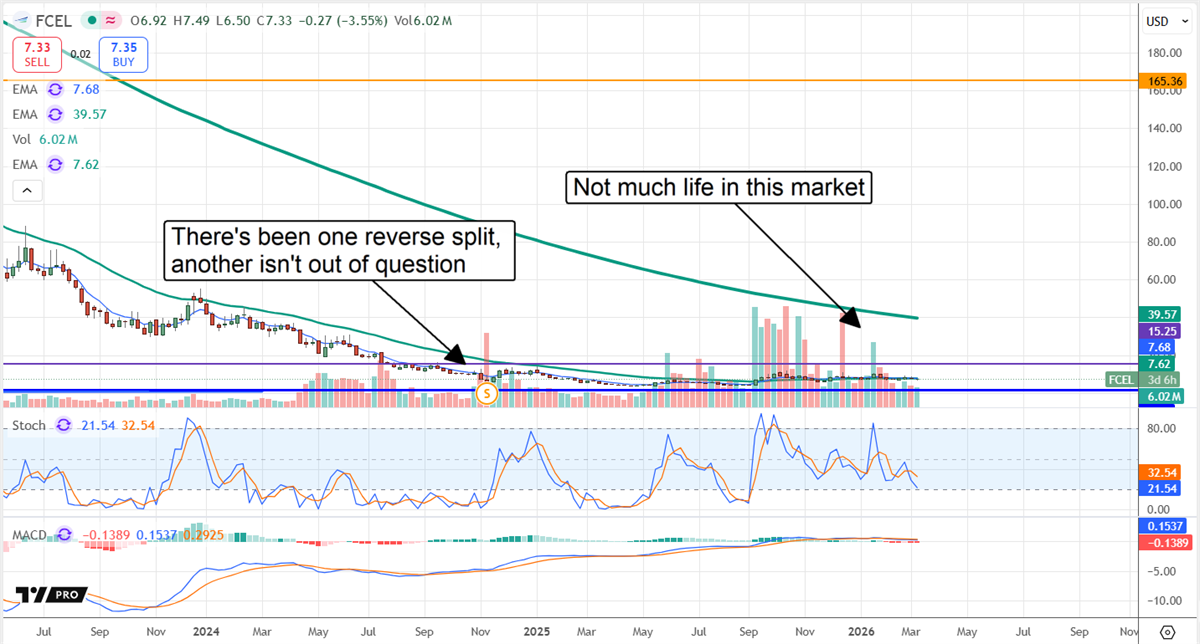
Competition Gains Momentum, FuelCell Doesn’t FuelCell’s Q1 release seemed solid at first glance, but a closer look shows its weaknesses. Revenue grew by 61% year-over-year, but this is due to last year’s weak results. Other comparisons show revenue down sharply sequentially, approximately 25% below the consensus target, and only average relative to the long-term. There is no strength in the number, and backlog figures suggest weakness may continue. The backlog declined nearly 11%, revealing the opposite of what FuelCell needs to show: deceleration. There is a ray of hope. The company’s products generate high-quality thermal energy that can power absorption chillers. They help reduce heat in the datacenter by generating water for water-cooled rack systems and can be integrated into FuelCell Energy’s systems. The company says it's submitted 1.5 GW in power proposals to data centers, a booming industry, and is now waiting to see which hyperscalers bite. The risk is that hyperscalers, who are interested in cheap, colocated power generation and any help with cooling, have ample choice. Competition is fierce, and other technologies appear to be gaining traction. While nuclear SMRs are the long-term target, near-term momentum is seen in companies like Bloom Energy (NYSE: BE), whose technology is also proven. Its revenue reflects actual growth, and profitability was achieved late in 2024.  Read This Story Online Read This Story Online |  Markets have been volatile lately, but dependable income opportunities still exist for investors who know where to look. We're reviewing a small group of high-yield dividend stocks that continue to generate strong cash flow despite shifting conditions. Our latest guide outlines three companies operating in energy, consumer staples, and consumer finance, each producing billions in free cash flow and offering yields above typical market averages. These are established, cash-producing businesses built to reward shareholders through consistent payouts, not speculation. If steady income matters in today's market, this breakdown is worth a closer look. Access the free dividend income guide and review all three stocks today |
| Written by Chris Markoch 
CrowdStrike Holdings Inc. (NASDAQ: CRWD) stock surged over 15% after its earnings, but the rally is losing strength. There’s nothing fundamentally wrong with CrowdStrike’s business model. The earnings report made that clear. To recap, CrowdStrike scored a beat on the top and bottom lines: - Reported EPS of $1.12 compared to analysts’ estimates of $1.10; up 38% year-over-year (YOY).
- Revenue of $1.31 billion exceeded analysts' estimates of $1.30 billion.
- Full-year annual recurring revenue of $5.25 billion was up 24% YOY.
- Operating income of $326 million was up 45% YOY.
- Cash flow from operations of $498 million was up 44% YOY.
And the list goes on and on. The issue comes down to valuation amid ongoing uncertainty surrounding the impact of artificial intelligence on software stocks. This may be a case of the more things change, the more they stay the same. The cybersecurity sector is one of the “must-own” sectors for investors for the next five to 10 years. But at what cost? Many cybersecurity stocks are expensive, and CrowdStrike is no different. Bullish investors would say the company deserves that premium for the outstanding numbers it’s delivering. At the same time, it’s fair to wonder if the company can continue to deliver similar growth numbers—something it will have to do to justify that premium in the future. The Bull Case Rests on Structural Tailwinds The case for CrowdStrike's premium is being driven by forces that show no signs of slowing. The rising frequency of cyberattacks in the form of ransomware, credential-based intrusions, and account takeovers continues to put pressure on enterprises and government institutions alike to invest in stronger defenses. CrowdStrike sits squarely in the path of that spending. And as its earnings report shows, it’s capturing more than its fair share of the market. - More than 50% of its customers use six or more Falcon platform modules.
- More than 34% use seven or more modules.
- More than 24% use eight or more modules.
These numbers follow CrowdStrike's goodwill gesture to customers after the 2024 outage. At that time, customers received one or more Falcon modules at no charge for a limited time. Many customers decided to keep and pay for those modules. The broader digital transformation wave compounds this demand. As healthcare, education, and public infrastructure deepen their reliance on cloud-based technology, their exposure to cyber risk grows with it. The expansion of 5G and the Internet of Things has only widened the attack surface that security vendors like CrowdStrike are being asked to protect. Where the Caution Comes In Even granting all of that, there are legitimate reasons to temper enthusiasm. Macroeconomic uncertainty has a way of causing enterprises to defer large IT commitments. Cybersecurity, despite being mission-critical, is not entirely immune to budget scrutiny. More pointedly, CrowdStrike's cost structure warrants close attention. The company continues to invest heavily in R&D and is aggressively expanding its sales force to capture market share. Those are the right moves strategically, but they put pressure on near-term margins—which matters a great deal when a stock is priced for perfection. How Expensive Is CRWD Stock? A company’s valuation must be viewed through several lenses. The first is relative to the broader market. Through that lens, CrowdStrike is expensive. But as big as it has become, this is still a growing company, and investors are typically willing to pay for growth. That’s why it's important to look at a company’s valuation in relation to its history. For example, CRWD’s forward price-to-book (P/B) ratio of 19.15x is below its current P/B of over 24x and well below its five-year average of around 30x. A similar story emerges with CrowdStrike's price-to-earnings (P/E) ratio. The forward P/E ratio is approximately 88x. That’s a hefty premium to the S&P 500, but it’s less than half of the company’s five-year historical average. Investors also need to consider the potential for future earnings, which the company projects to grow by 30.3% in 2027, 27% in 2028, and 31.3% in 2029. Is There Still a Dip to Buy? It’s a tough question. On the one hand, CRWD stock is expensive even if you consider the potential upside from the most bullish analysts. The same could be said of other technology stocks, such as Palantir Technologies Inc. (NASDAQ: PLTR). In any event, the risk-reward balance still favors the bulls at the moment. More risk-averse investors may want to consider investing in CrowdStrike via an exchange-traded fund (ETF) such as the WisdomTree Cybersecurity Fund (NASDAQ: WCBR). This is a good way to get diversified exposure to the entire sector. Read This Story Online |  Spot the Signals Before They Become Obvious
We track early shifts in volume, structure, and emerging trends as they begin to form.
Trading Ideas focuses on data patterns that often develop before broader visibility. Join Free — Start Seeing the Data Early |
| Written by Leo Miller 
Advertising technology stock The Trade Desk (NASDAQ: TTD) has experienced highly disappointing performance recently, with shares down more than 50% over the past 52 weeks. However, the stock recently received a significant shot in the arm, with shares surging more than 18% on March 5. This came on reports that The Trade Desk is in talks with OpenAI to help companies place advertisements in ChatGPT. Reports indicate that the potential partnership is in the early stages of negotiations. The excitement related to even a possible partnership makes sense. ChatGPT now has 900 million weekly active users. If Trade Desk were to become one of OpenAI’s key partners, a flood of advertising dollars could potentially flow through its platform. Let’s break down what this all really means and to what extent it changes the picture around TTD stock. ChatGPT: TTD’s LLM Advertising Opportunity When it comes to OpenAI, markets are increasingly concerned about the company’s ability to consistently generate revenue that exceeds its costs, i.e., to be profitable. Thus, the company has begun seeking additional avenues to accelerate revenue growth. One of the key verticals it’s introducing is advertisements on ChatGPT. Specifically, in January, the company said that it plans to start testing ads in the United States in its free and Go tiers. Its Plus, Pro, Business, and Enterprise tiers will not include ads. For Trade Desk, this represents a considerable opportunity. Trade Desk partners with companies looking to generate ad sales (such as OpenAI). When companies looking to place ads use TTD’s platform, it takes a percentage of their ad spend. The rest flows to its partners, which could include OpenAI. In the context of this discussion, the partnership would be even more compelling when considering the stratification of OpenAI’s user base. Reports suggest that as of July 2025, only 5% of OpenAI’s users were on its Plus or Pro tiers. OpenAI also said in November 2025 that it had a total of seven million ChatGPT for Work seats. The numbers are imprecise, but the overall story holds: the vast majority of ChatGPT users are on the free and Go tiers. Thus, for Trade Desk, a partnership with OpenAI could enable the firm to facilitate ad buying across a large portion of ChatGPT’s user base. Criteo, Perplexity, and OpenAI: The Evolution of LLM Advertising Adding weight to these rumors is the fact that OpenAI has already partnered with a company similar to Trade Desk: Criteo (NASDAQ: CRTO). Criteo is OpenAI’s first advertising technology partner, integrating with its ad push. Some of the early data from Criteo is promising. The company says that when advertisers receive referrals from users through LLMs like ChatGPT, they convert at 1.5 times the rate of other channels. This means that advertisers get significantly more interest from potential customers when placing ads in LLMs. This creates a compelling reason for them to push ads through this channel. Notably, Criteo is a much smaller ad-tech player compared to Trade Desk. The company says it activates over $4 billion in ad spending annually. This is less than a third of the $13.4 billion in gross spending that flowed through Trade Desk’s platform in 2025. Thus, it’s possible that OpenAI is testing this arrangement with Criteo and seeing if it sticks. If successful, the firm could also begin working with larger players, such as Trade Desk. Still, there is some reason to believe OpenAI’s advertising ambitions could prove untenable. Artificial intelligence (AI) search tool Perplexity recently reversed course on its advertising push, citing concerns that ads could reduce consumer trust in its platform. This is one of the key issues that OpenAI’s advertising ambitions face. However, there is one key difference between ChatGPT and Perplexity: user base. Perplexity’s user base is in the “tens of millions," a fraction of ChatGPT’s. Larger user groups improve ad targeting, making ChatGPT a much more desirable platform for ad buyers. ChatGPT’s larger user base also represents a much bigger opportunity for advertisers, making them more likely to buy on the platform. Furthermore, Perplexity is shifting its focus to enterprise adoption rather than consumers, while OpenAI is targeting both. With a massive consumer user base, OpenAI is less likely to abandon ads. TTD: Beaten Down Stock Facing Significant Uncertainty Going Forward At current levels, TTD’s valuation prices in long-term growth that is far below what it has historically generated. This isn’t entirely unwarranted, given that revenues rose by just 14% last quarter amid intensifying competition. This was the firm’s lowest growth rate in over five years, and a large drop compared to 22% growth in Q4 2024. Still, there is reason to believe that the market is too pessimistic about TTD’s outlook, especially if the OpenAI deal materializes. The consensus price target on TTD sits near $43, implying over 50% upside. However, targets updated after the company’s latest earnings report are considerably lower, averaging around $34. This implies less than 20% upside compared to the stock’s current level near $29. There is substantial disagreement among analysts, with targets ranging from $17 to $55. Overall, despite the OpenAI potential, it remains difficult to be overly confident in Trade Desk’s future. Read This Story Online |  Every morning before the market opens, an AI scoring engine analyzes 357 stocks across 6 dimensions — the same dimensions used by the world's greatest investors.
Buffett-style quality. Deep value. Macro trends. Upcoming catalysts. Smart money flow. Technicals.
Each stock gets a score from 0 to 10. The top 10 make the list. *See Today's Top 10 AI-Ranked Stocks* |
| More Stories |
| |
|
Popular posts from this blog
ONCE every 4 years Sale ͏ ͏ ͏ ͏ ͏ ͏ ͏ ͏ ͏ ͏ ͏ ͏ ͏ ͏ ͏ ͏ ͏ ͏ ͏ ͏ ͏ ͏ ͏ ͏ ͏ ͏ ͏ ͏ ͏ ͏ ͏ ͏ ͏ ͏ ͏ ͏ ͏ ͏ ͏ ͏ ͏ ͏ ͏ ͏ ͏ ͏ ͏ ͏ ͏ ͏ ͏ ͏ ͏ ͏ ͏ ͏ ͏ ͏ ͏ ͏ ͏ ͏ ͏ ͏ ͏ ͏ ͏ ͏ ͏ ͏ ͏ ͏ ͏ ͏ ͏ ͏ ͏ ͏ ͏ ͏ ͏ ͏ ͏ ͏ ͏ ͏ ͏ ͏ ͏ ͏ ͏ ͏ ͏ ͏ ͏ ͏ ͏ ͏ ͏ ͏ ͏ ͏ ͏ ͏ ͏ ͏ ͏ ͏ ͏ ͏ ͏ ͏ ͏ ͏ ͏ ͏ ͏ ͏ ͏ ͏ ͏ ͏ ͏ ͏ ͏ ͏ ͏ ͏ ͏ ͏ ͏ ͏ ͏ ͏ ͏ ͏ ͏ ͏ ͏ ͏ ͏ ͏ ͏ ͏ ͏ ͏ ͏ ͏ ͏ ͏ Free Shipping on Orders of $24.99 or more ...
Get Images Library Photos and Pictures. Шапки YouTube 🔝 psd баннер для канала, скачать готовый фон 2560x1440 и 2048x1152 - SY Быстрый и удобный сервис для создания мемов :) | Игровые арты, Красочные картины, Баннер Шапки YouTube 🔝 psd баннер для канала, скачать готовый фон 2560x1440 и 2048x1152 - SY Картинки для ютуба 2048x1152, шапка канала 2560x1440, скачать изображение - SY
View Images Library Photos and Pictures. L´ANTENNE BOUCLE MAGNÉTIQUE Les cadres antiparasites, antenne ferrite, antenne cadre. Céria - Radio club de Saint Nazaire - F6KBG - ANTENNE CADRE OCTOGONALE BANDES BASSES Antenne loop magnétique - Site du Radio Club F6KFT
|




Comments
Post a Comment