I’ve spent over 5 decades cutting my teeth in the markets…
That journey’s taken me from the trading desk as a professional securities trader and broker…
To teach thousands of regular folks the lessons I learned the hard way.
And I’ll be straight with you… Weekday trading just isn’t what it used to be.
Markets are quick to react to the news, headlines whip prices back and forth, and by Friday, most traders are worn out with little to show for it.
But here’s the twist… more and more, the real fireworks have been happening towards the weekend.
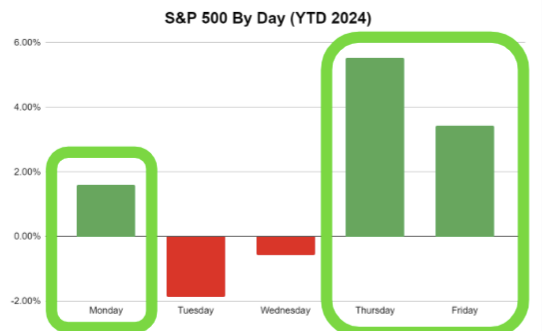
And it’s not random...
The weekend market pattern has been unfolding for a while…
One that lets you sidestep the weekday noise and focus only on the stretch where stocks tend to make their biggest bullish moves.
That’s the shift I’ve been tracking… the “Weekend Income” discovery.
It all revolves around a simple three-letter ticker most people ignore… yet this approach has shown shocking accuracy.
All without chasing headlines or riding the emotional rollercoaster of daily trading.
If you’d like to see a straightforward way to give yourself a shot at extra income, while the markets are closed.
See how the “Weekend Income” play works here.
By clicking the link above you agree to periodic updates from Diversified Trading Institute and its partners (privacy policy)
SoundHound's Agentic AI Push Could Be Right—Even if the Chart Isn't
Submitted by Chris Markoch. Originally Published: 1/28/2026.
At a Glance
- SoundHound AI is expanding beyond voice into agentic AI with new Amelia 7 capabilities, broadening use cases from conversation to task execution.
- The business has real, growing revenue, but the market is balancing that against a lack of profitability and a premium valuation near 48x sales.
- Momentum is still technically bearish, and low institutional ownership plus high short interest point to elevated volatility ahead of the next earnings update.
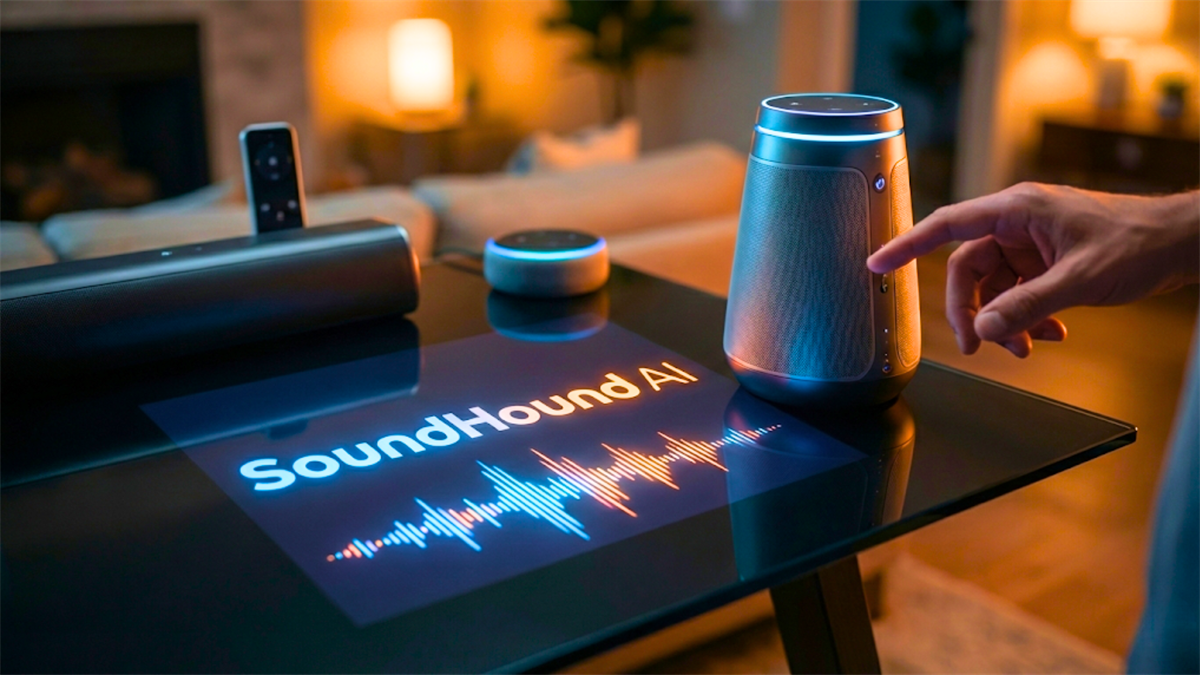
SoundHound AI Inc. (NASDAQ: SOUN) got off to a strong start in 2026. The company unveiled new features for its Amelia 7 agentic AI platform at the Consumer Electronics Show (CES) in Las Vegas. Those additions extend SoundHound's conversational AI into AI agents that can order food, make dinner reservations, pay for parking, and book travel.
This is an important step for a company that has been producing strong year‑over‑year revenue growth. However, an early lead doesn't automatically become a durable moat. These new features help build that moat, particularly in the growing autonomous vehicle sector.
The biggest scam in the history of gold markets is unwinding (Ad)
There are 90 paper gold claims for every real ounce in COMEX vaults. Ninety promises, one ounce of metal. It's like musical chairs with 90 players and one chair. COMEX gold inventory dropped 25 percent last year alone as gold flows East to Shanghai, Mumbai, and Moscow. On March 31st, contract holders can demand delivery. When similar situations arose in the past, markets closed and rules changed. Paper holders got crushed while mining stock holders made fortunes. One stock sits at the center of this crisis.
Get the full story on this opportunity now.For investors, two plausible things can be true at once. Among AI-related stocks, SoundHound has a compelling narrative backed by real and expanding revenue. At the same time, the company isn't profitable and trades at a price‑to‑sales (P/S) ratio of roughly 48x — a rich valuation at a time when investors are less willing to pay large premiums for speculative names.
From April through October 2025, SOUN was one of the best-performing tech names. Since then the stock has entered a bearish pattern of lower highs and lower lows. Even after the CES announcements, SOUN is down more than 8% in the first month of 2026.
That weakness largely reflects a broader rotation away from technology stocks. If SOUN is being mispriced relative to its prospects, however, the pullback could present a buying opportunity.
Agentic AI Is Where the Sector Is Moving
Generative AI — chatbots and content generation — dominated headlines in 2024, but the technology is evolving. The next wave is agentic AI: systems that operate autonomously to perform tasks with little or no human supervision. It's less about conversation and more about execution, turning user intent into coordinated action across multiple systems.
Amelia Expands SoundHound's Agentic Capabilities
SoundHound's acquisition of Amelia, announced in November 2024 and completed in early 2025, materially broadened its conversational AI vision. Amelia brings enterprise‑grade agents designed for customer service, IT support, and internal business workflows.
Those agents can reason through complex requests, access structured enterprise data, and execute tasks across back‑end systems. In short, Amelia shifts SoundHound from voice‑first interactions to full‑stack, agentic AI for enterprises.
That positions SoundHound not just as a voice‑AI vendor but as an action layer for agentic AI — a critical role as companies move AI out of experimentation and into production.
Why This Matters for Investors
Agentic AI benefits platforms that can operate reliably in real‑time environments such as cars, restaurants, call centers, and enterprise systems. SoundHound already runs at scale in many of these settings and is generating revenue today rather than promising it for tomorrow.
Valuation is a valid concern, but the Amelia deal expands SoundHound's total addressable market and aligns it with where AI spending is likely to go next. If agentic AI adoption accelerates, the recent pullback could reflect temporary investor caution rather than a broken business story.
Sentiment on SOUN Stock Is Mixed
SoundHound won't report earnings until late February, so investors will need to wait to see how customers respond to the new features.
Analyst views are mixed. The consensus price target for SOUN is $16.07, roughly 61% above the stock's closing price on Jan. 27. Still, MarketBeat's analyst listings show two analysts with Sell ratings published in January.
Technically, SoundHound's daily chart is tilted to the downside. Shares trade below both the 50‑day and 200‑day moving averages, and the 50‑day sits below the 200‑day — a "death cross" that signals medium‑term momentum has rolled over. SOUN has pulled back sharply from its 52‑week high near $22 and continues to register lower highs and lower lows, a classic downtrend. Volume spikes on selloffs have yet to be followed by sustained accumulation, suggesting buyers remain tentative.
Oversold indicators leave room for a short‑term bounce, but without a higher low and a decisive move back above the 50‑day average, any rally would be counter‑trend rather than a confirmed reversal.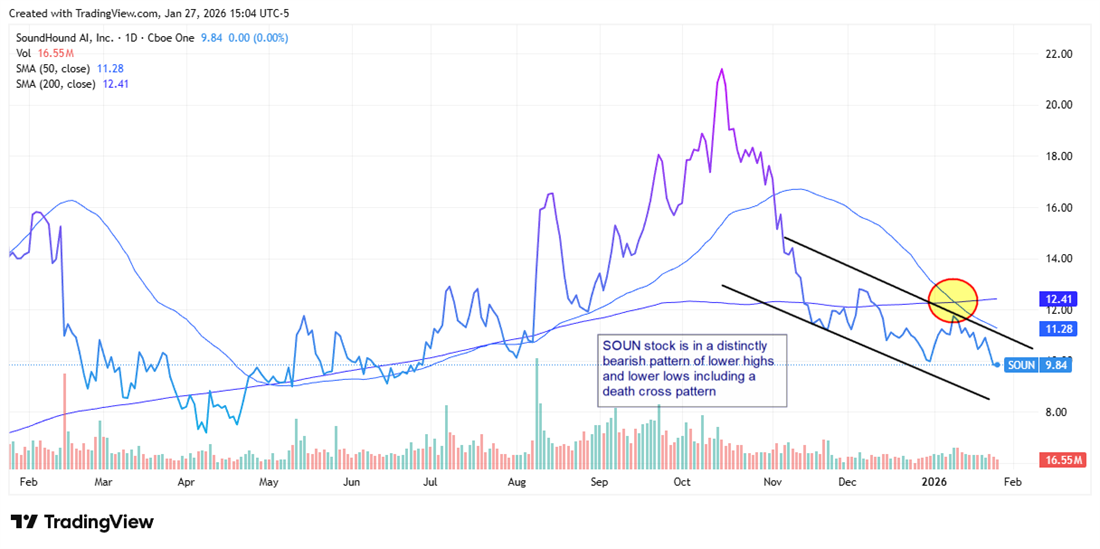
Compounding the price action, less than 20% of SOUN is institutionally owned and short interest exceeds 29%. That mix creates high volatility, so investors should have a high risk tolerance and a sufficiently long time horizon before taking a position in SOUN.
This message is a paid sponsorship sent on behalf of DTI Trader, a third-party advertiser of MarketBeat. Why did I get this email message?.
If you need assistance with your subscription, please contact our South Dakota based support team at contact@marketbeat.com.
If you would no longer like to receive promotional emails from MarketBeat advertisers, you can unsubscribe or manage your mailing preferences here.
© 2006-2026 MarketBeat Media, LLC. All rights reserved.
345 N Reid Pl., Sixth Floor, Sioux Falls, S.D. 57103-7078. United States of America..
Comments
Post a Comment