 
The AI Arms Race Is Exposing a Much Bigger Need Every major tech company is racing to build the smartest chatbot, the fastest AI assistant, the most capable model. Billions are being spent on software and algorithms. But all of these tools share the same fundamental requirement: physical infrastructure. Power. Capacity. Locations that can actually support nonstop computing at scale. As AI usage explodes, attention is quietly shifting away from the apps people see - and toward the physical layer that makes growth possible. Discover the company positioned at this foundation > 
Wednesday's Bonus Story The Late-Stage Bull Market Is a Buying Opportunity for TechReported by Jordan Chussler. Posted: 2/24/2026. 
Key Points- Despite the NASDAQ falling 5% from its October high and tech currently lagging the S&P 500, analysts argue this is late-stage bull market maturity rather than the end of the cycle.
- Several major names—including Adobe, Intuit, and The Trade Desk—are trading at Relative Strength Index levels well below 30. Combined with significant year-to-date losses, these stocks are oversold.
- Improving valuations, including Meta’s forward P/E of 24.13 and Adobe’s 14.78, indicate that earnings potential is becoming cheaper.
- Special Report: Introducing "Elon Musk's Day-One Retirement Plan" (From Brownstone Research)

After years of leading the pack, the tech sector has been in retreat since the NASDAQ hit its all-time high last October. While this sell-off has fueled speculation that the market has entered the late stages of its bull run, discerning investors may see buying opportunities in names that haven't been on sale for a while. Tech stocks finished 2025 with nearly a 34% gain, but after a 1.68% drop on Feb. 23, the group sits about 2.15% lower year-to-date (YTD), the second-worst performance among the S&P 500's 11 sectors. Much of this reflects the underperformance of most of the Magnificent Seven, which has driven flows into defensive sectors and equal-weight ETFs, alongside concerns about an AI bubble and broad selling in software stocks. Rumblings of a potential bear market raise the risk of further downside in tech. Even so, valuations have become more attractive, and analysts argue the growth-heavy sector now offers value. A Late-Stage Bull Market Doesn't Mark Its EndAndrew Slimmon, head of the applied equity advisors team at Morgan Stanley (NYSE: MS), noted in the firm's 2026 market outlook that a late-stage bull market is not synonymous with the end of the cycle. Slimmon acknowledged the cycle is mature but not over, noting that bull markets typically last five to seven years and "history favors the bull market in a fourth year," which is where the market sits in 2026. Those years have historically delivered positive returns. As Slimmon put it, "investors who take higher risk may be rewarded in the coming year, and while corrections are likely in a potentially volatile year for stocks, that could be healthy and support the broader trend upward." The NASDAQ is undergoing a pullback, down more than 5% from its October high, while several individual tech stocks are already in correction territory, including some Magnificent Seven names. Both Amazon (NASDAQ: AMZN) and Meta Platforms (NASDAQ: META) are down more than 19% from their respective one-year highs. For Palantir (NASDAQ: PLTR), losses from its one-year high are nearly 37%. AI-focused CRM provider HubSpot (NYSE: HUBS) has plunged more than 43% YTD, and International Business Machines (NYSE: IBM) fell more than 13% on Feb. 23 alone. That does not automatically make any of these names a buy. However, the market's flight to safety has disproportionately benefited sectors like energy, materials, and industrials, leaving numerous tech stocks oversold. Evidence of a Buying OpportunityThe case can be made with both technical and fundamental analysis. The NASDAQ's current Relative Strength Index (RSI) reading of 41.4 is moving toward the 30 threshold that typically indicates oversold conditions. At the same time, the index is trading below its 50-day moving average, suggesting further downside is possible before the 200-day moving average provides support and a potential reversal. 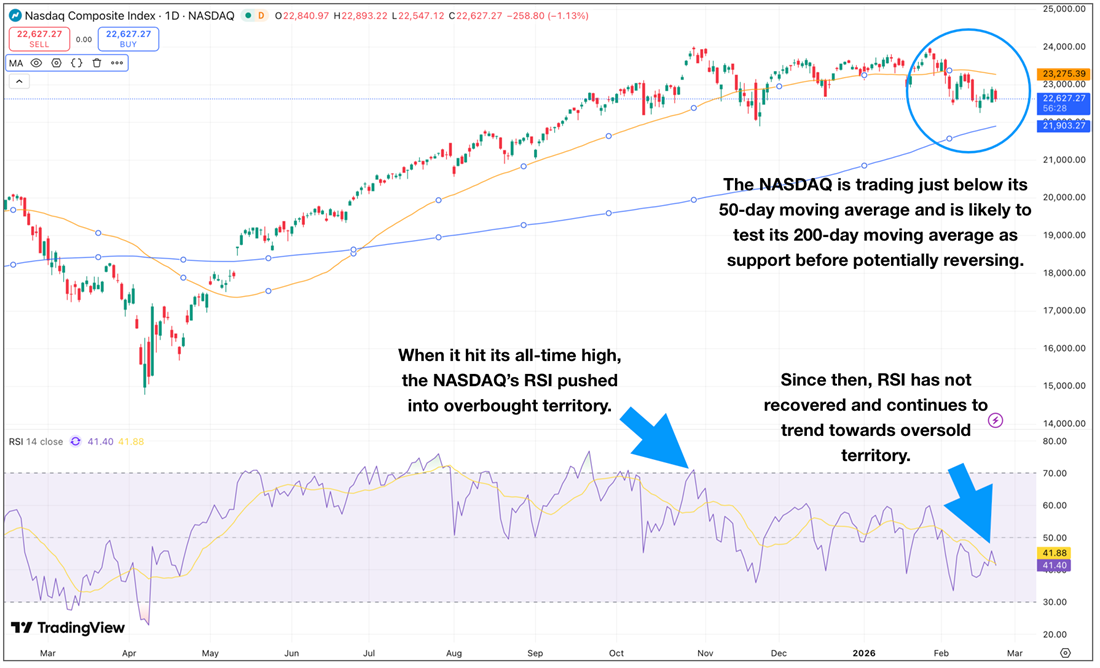
MarketBeat has identified dozens of oversold tech stocks, some with RSI readings well below 30 that are hard to ignore — and analysts' price targets reflect substantial potential upside: While these figures can change quickly, the sector-wide theme is clear: for investors who still believe in technology's long-term bull case, the red market presents a compelling opportunity. Many of these companies are improving fundamentally as well. For example, Meta's trailing 12-month (TTM) price-to-earnings (P/E) ratio of 27.37 looks elevated, but its forward P/E of 24.13 implies stronger earnings ahead. Meta's year-over-year (YOY) earnings-per-share (EPS) growth over the past three years illustrates the point: after a post-bear-market surge of more than 73% YOY in 2023 and nearly 61% YOY in 2024, last year's figure fell to -1.55%, suggesting the possibility of a regression toward the short-term mean this year. That pattern appears outside the Magnificent Seven as well. Adobe's forward P/E is 14.78, Paychex's is 17.72, and Accenture's is 15.77. Their respective five-year average annual EPS growth rates are 10.01%, 9.01%, and 9.20%.
We are not securities dealers or brokers, investment advisers or financial advisers, and you should not rely on the information herein as investment advice. Any investment should be made only after consulting a professional investment advisor and only after reviewing the financial statements and other pertinent corporate information. Further, readers are advised to read and carefully consider the Risk Factors identified and discussed in the profiled company's SEC and/or other government filings. Investing in securities, particularly microcap securities, is speculative and carries a high degree of risk. | 
Comments
Post a Comment