Confirm Your Name Before the Letter Goes Out (From American Alternative)
In Brief
- Bloom Energy offers data centers a rapid power solution and efficient architecture that successfully bypasses traditional utility grid delays.
- Strategic partnerships with major asset managers and utilities have validated the technology and secured a massive backlog of future product orders.
- The company has achieved operating profitability while favorable government legislation provides long-term certainty for tax credits and expansion.
For the past two years, the stock market has been obsessed with the brains of the artificial intelligence (AI) revolution. Investors poured billions into companies designing advanced chips and building large language models, driving valuations to historic highs. However, while the market focused on computing power, a massive physical bottleneck quietly emerged that now threatens to derail the entire industry: a global shortage of electricity.
The United States' electrical grid is aging, congested, and struggling to meet modern demand. In major data center hubs like Northern Virginia and Silicon Valley, interconnection queues (the waiting list to connect new commercial facilities to the power grid) now stretch three to five years. This delay is catastrophic for technology giants.
These companies need to bring billions of dollars of AI chips online immediately to remain competitive. An AI data center cannot function without massive, continuous, and reliable power, and the traditional utility model is failing to keep up.
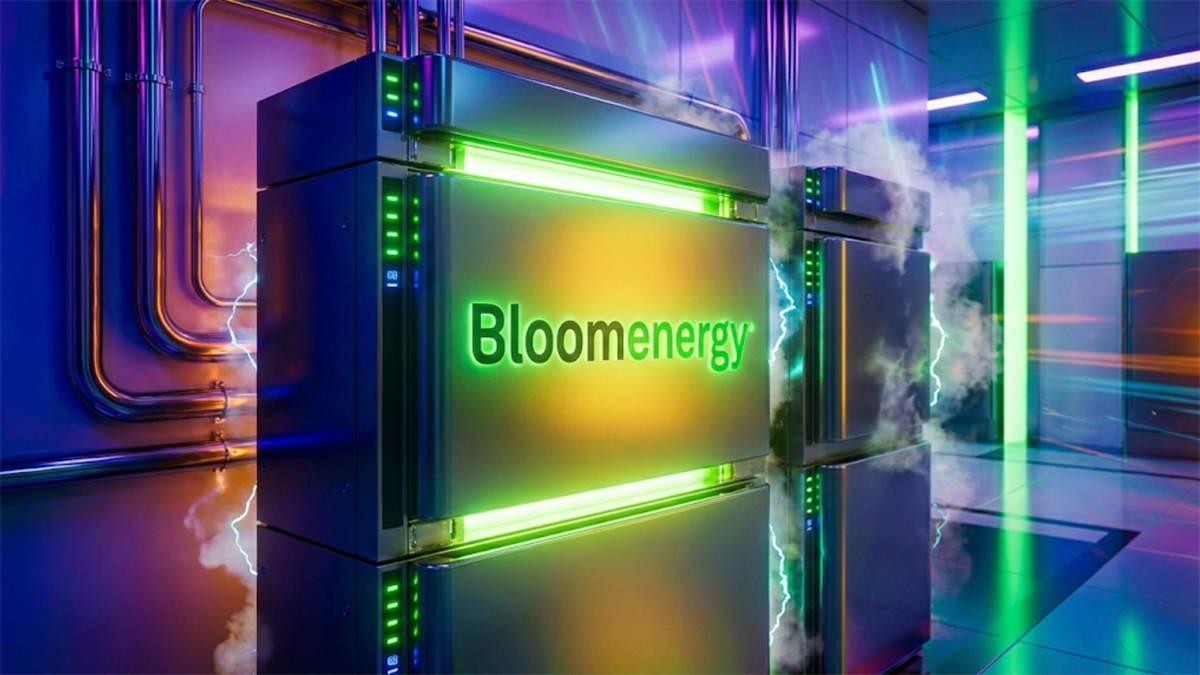
Enter Bloom Energy (NYSE: BE). Once viewed primarily as a speculative bet on a future hydrogen economy, Bloom has successfully pivoted its business model to address this immediate crisis. It is no longer just a clean energy company; it is a critical infrastructure provider offering a rapid time-to-power solution that bypasses the utility grid entirely.
Wall Street is waking up to this new reality. The stock has risen approximately 489% over the last year, driven by the realization that Bloom provides the physical heartbeat required to keep the AI revolution alive. The company's recent fourth-quarter earnings report validated this momentum, delivering earnings per share (EPS) of 45 cents, significantly beating analyst expectations of 25 cents.
For the first time ever, James Altucher – one of America's top venture capitalists – is sharing how ANYONE can get a pre-IPO stake in SpaceX… with as little as $100!
[[Click here now to view.]]
The Competitive Moat: Speed and Physics
The primary reason Bloom Energy is winning contracts over traditional utilities is one critical metric: speed. In the high-stakes world of AI, time is money. Every month, a data center sits idle waiting for a power connection, representing millions of dollars in lost revenue and lost market share.
Traditional utilities often require years to upgrade transmission lines and substations to support a new hyperscale facility. Bloom Energy offers a workaround. By installing its solid-oxide fuel cells on-site, Bloom essentially turns a data center into its own independent power plant. During the recent earnings call, CEO KR Sridhar confirmed that the company deployed a hyperscale AI factory order in just 55 days. This stands in stark contrast to the standard 90-day commitment Bloom usually offers and the multi-year delays common with traditional grid connections.
Beyond speed, Bloom holds a distinct engineering advantage rooted in physics. The traditional electrical grid delivers power as Alternating Current (AC). However, computer chips and server racks run on Direct Current (DC). Connecting a data center to the grid requires expensive, heavy, and inefficient equipment to convert that AC power into DC. This conversion process is wasteful; it loses energy as heat, which then requires even more energy to cool.
Bloom's Energy Servers generate electricity natively in DC. The company's new 800-Volt DC architecture allows its fuel cells to connect directly to AI server racks. This creates a streamlined power architecture that eliminates multiple conversion steps, removing the need for massive transformers and rectifiers. The result is a system that is more energy-efficient, generates less waste heat, and occupies a smaller physical footprint. For data centers where floor space is premium real estate, this physical efficiency is a significant competitive moat.
Institutional Validation: The $20 Billion Backlog
The transition from a niche energy product to essential infrastructure is confirmed by the caliber of contracts Bloom is signing. The technology is no longer a science experiment; it is being deployed at an industrial scale by some of the largest capital allocators in the world.
In late 2025, Bloom announced a massive strategic partnership with Brookfield Asset Management. Brookfield established a $5 billion financing framework specifically to deploy Bloom's fuel cells. This deal serves as a vote of confidence from smart money, validating the asset class and providing Bloom with a funded pathway to scale. Importantly, this allows Bloom to deploy units without leveraging its own balance sheet for every project, preserving capital for manufacturing expansion.
Utilities are also recognizing that they cannot meet demand alone. American Electric Power (NASDAQ: AEP), one of the largest utility companies in the U.S., signed a supply agreement for up to 1 Gigawatt (GW) of solid oxide fuel cells. This deal signals a shift in the utility mindset: rather than viewing on-site generation as competition, major utilities are now partnering with Bloom to solve their own capacity constraints.
Further validation comes from the tech sector itself. Bloom's collaboration with Oracle (NYSE: ORCL) to power AI data centers included warrants for Oracle to purchase over 3.5 million shares of Bloom stock. This creates a financial alignment where a major customer benefits directly from Bloom's success. These strategic wins have driven the company's product backlog to approximately $6 billion, a 140% year-over-year increase. When combined with long-term service agreements, the total backlog now sits at roughly $20 billion, providing high visibility into future revenue streams.
The same seven red flags that preceded the 1929 crash, '70s stagflation, and the 2008 meltdown are all flashing together right now — long before the headlines catch up. Our free Bellwether Signal Report breaks down each warning in plain language and explains why more Americans are shifting from vulnerable paper assets into hard assets like gold and silver IRAs. If you want to stay ahead of the next major market turn, now is the time to act.
Claim your free Bellwether Signal Report before the next leg down
Growth, Guidance, and Government Support
The financial data supports the bullish narrative surrounding the stock. Bloom Energy finished fiscal year 2025 (FY2025) with record revenue of $2.02 billion, a 37% increase over the previous year. However, the forward-looking guidance paints an even stronger picture. Management projects revenue for FY2026 to land between $3.1 billion and $3.3 billion. If achieved, this would represent year-over-year growth exceeding 50%.
Crucially, the company has turned a corner on profitability. For FY2025, Bloom reported non-GAAP operating income of $221 million. This achievement distinguishes Bloom from many of its peers in the clean energy sector, such as Plug Power (NASDAQ: PLUG), which continues to struggle with significant cash burn and negative margins. Bloom has proven it can grow its top line while maintaining fiscal discipline.
Investors also benefit from a stabilized policy environment. The One Big Beautiful Bill Act (OBBBA), passed in 2025, reinstated the 30% Investment Tax Credit (ITC) for fuel cells. This legislation is a game-changer because it applies regardless of the fuel source. Whether a customer runs their Bloom Box on natural gas today or transitions to hydrogen tomorrow, they qualify for the credit. This tax credit is locked in for projects starting construction through the end of 2033, creating a long-term floor for customer return on investment. This decade-long certainty allows customers to sign large, multi-year contracts without worrying about political winds shifting.
Scaling for the Future: A Derivative AI Trade
Bloom Energy has successfully decoupled itself from the volatile and often unprofitable clean energy sector to become a derivative trade on artificial intelligence. While the company faces the operational challenge of doubling its Fremont, California, manufacturing capacity to 2 GW by the end of 2026, it is well-capitalized to execute this plan. The company ended 2025 with a strong balance sheet holding approximately $2.5 billion in cash.
Furthermore, the company's business model includes a powerful recurring revenue engine. Every product sold comes with a 100% attachment rate to long-term service contracts. As the installed base grows, so does the steady stream of high-margin service revenue, building a compounding financial foundation for the future.
For investors seeking exposure to the AI boom without paying the premium valuations of chip manufacturers, Bloom Energy offers a compelling alternative. It provides the essential physical infrastructure required to keep the digital revolution running. As long as data centers need power faster than the grid can provide it, Bloom is positioned to grow.
Read this article online ›
Stay Ahead of the Market
The best investment opportunities don't wait. Get our research and stock ideas delivered straight to your smartphone—so you never miss a market-moving opportunity. Our text alerts ensure you see timely stock ideas and professional research reports instantly, whether you're in a meeting, commuting, or away from your desk.
Get Text Alerts from American Market News (free)



Comments
Post a Comment