AI’s surging energy demand is creating new winners
AI workloads are scaling and data centers are expanding rapidly — driving unprecedented demand for electricity, cooling, and grid infrastructure.
Massive capital is flowing to the companies that enable AI at scale — the power producers, infrastructure owners, and critical technology suppliers behind the scenes.
In this FREE report, we reveal five publicly traded companies positioned to benefit directly from the AI energy buildout.
Inside, you’ll discover:
- A data-center landlord gaining pricing power
- A stealth REIT pivoting to AI infrastructure
- A monopoly supplier embedded in advanced AI chips
- A nuclear power leader partnering with Big Tech
- An industrial firm modernizing the electric grid
As AI growth increasingly depends on energy and infrastructure, these companies sit at the center of the next opportunity.
👉 Click here to see the 5 stocks positioned for AI’s biggest energy demand shift in decades
(By clicking the links above, you agree to receive future emails from us and bonus subscriptions from our partners. You can opt out at any time. - Privacy Policy)
To Your Trading Success,
The Stock Alert Daily Team
Waiting for Walmart to Pull Back? Now's the Time to Buy
Submitted by Thomas Hughes. First Published: 2/19/2026.
Key Points
- Walmart is creating a buying opportunity for investors following weaker-than-expected F2027 guidance.
- The uptrend remains intact, with analysts suggesting a 10% upside from the early 2026 highs.
- Cash flow, capital return, and institutional support underpin the price action.
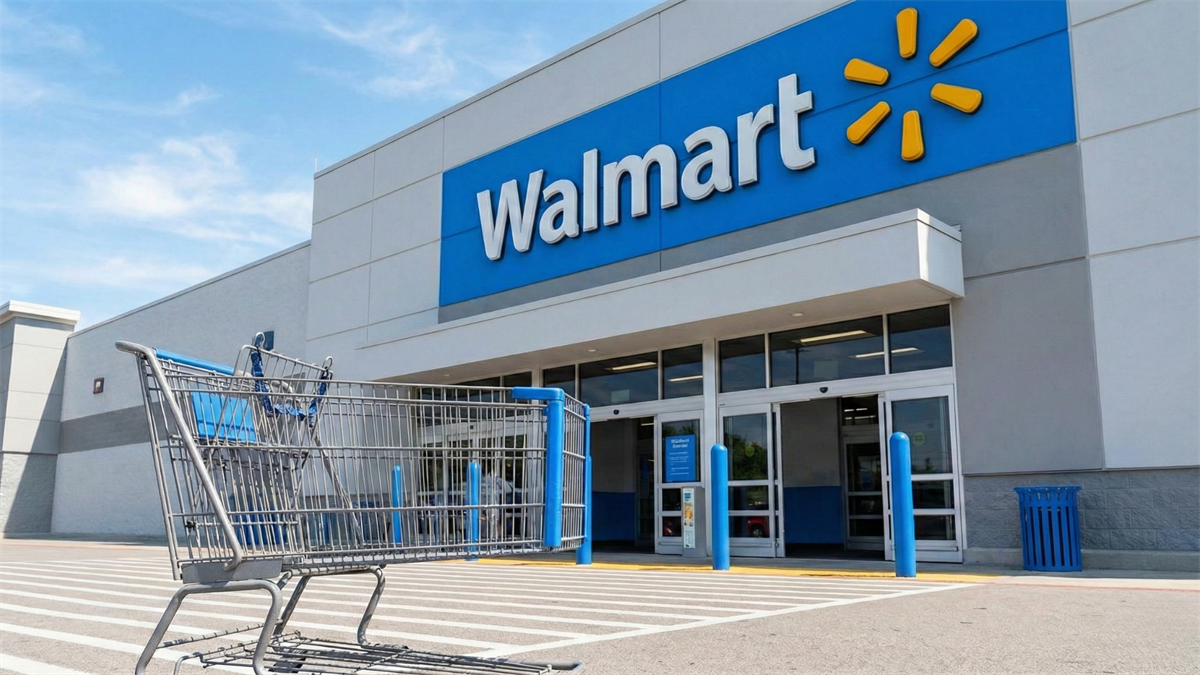
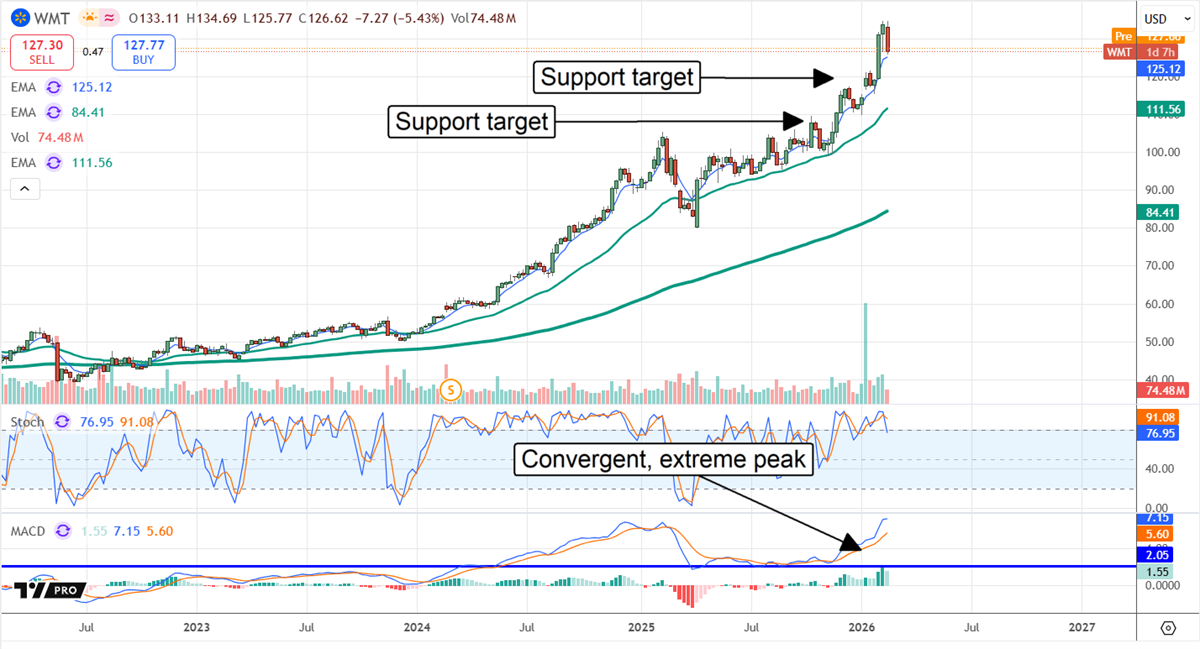
Investors waiting for Walmart (NASDAQ: WMT) shares to pull back into an entry point have reason to be patient. The stock peaked ahead of the Q4 2026 earnings report and has since begun to decline. Technical indicators suggest the stock remains in a longer-term uptrend but could retreat into the $120 to $110 range before finding a bottom and rebounding. If that pullback occurs, upside potential could be in the low-double-digit annualized range (CAGR), including dividends and share price gains, over the coming years.
Walmart's stock price action is driven by cash flow as much as by growth. Cash flow helps sustain balance sheet health and supports ample, reliable capital returns and reinvestment that are expected to grow over time. The dividend yield was about 0.8% as of mid-February 2026, with a payout ratio around 35% of expected earnings and a 52-year history of consecutive increases. Share buybacks are also steady and reduce the share count quarterly; the board recently authorized a new $30 billion repurchase program, roughly 3% of the pre-release market cap.
Analyst Caution Doesn't Mean Sell: A Buying Opportunity
Why are central banks buying before March 31? (Ad)
Central banks bought more gold last year than in any year since 1967 — and the pace is accelerating just as physical demand begins to overwhelm paper supply. The next major delivery cycle opens March 31, when paper contract holders can demand physical gold from Western vaults. Dylan Jovine at Behind the Markets has identified one small company sitting on one of the largest undeveloped gold deposits in North America, positioned to benefit if this supply-demand imbalance intensifies after the delivery window opens.
See Dylan Jovine's Gold Miner Pick Before the March 31 Delivery WindowAnalysts expressed some caution after Walmart's Q4 release; however, they generally remain optimistic and support the stock's outlook. MarketBeat tracks 35 analyst reports (published within the last 12 months), showing increased coverage, firmer sentiment, and a 94% buy-side bias. The consensus price target is up roughly 30% over the trailing 12 months and climbed into the report's release.
Recent updates include an upgrade to Strong Buy from Argus and numerous price-target boosts or reiterations, which have pushed the range's high to $150. A move to $150 would be notable because it would sit about 10% above the stock's all-time high.
The technical setup looks constructive. Although price action peaked ahead of the report, it remains inside a broader uptrend.
Indicators align with that view: the MACD shows convergence with the recent high and marks its strongest peak on record.
Together, these signals point to a strengthening market that is likely to at least retest the recent high after the current pullback. In that scenario, a retest would be the minimum target; a move to new highs is possible.
Institutional investors own roughly 25% of Walmart, while the Walton family controls an estimated 50% or more — together commanding nearly 80% of the stock.
Institutions have been net buyers: over the trailing 12 months they purchased more than $2 for every $1 sold, with buying activity accelerating in early Q1 2026. In January and early February the ratio approached $2.50 bought per $1 sold, coinciding with Walmart's run to record highs. That behavior suggests a solid support base likely to step in near or just below the $120 level.
Walmart Guidance: Conservative Amid Bullish Trends
Walmart's guidance was conservative. Management guided Q1 and full-year 2027 revenue and earnings below consensus, while still expecting growth, margin strength, and ample cash flow. Given the Q4 outperformance and strength across key consumer channels, the outlook appears intentionally cautious.
eCommerce led the gains, up about 24% systemwide, driven by same-day pickup and delivery services. The advertising business grew 37% globally and 41% in the U.S. Walmart U.S. comparable sales rose 4.6%, helped by ticket size and traffic. Sam's Club comps increased 4%, supported by a 6.9% rise in membership-fee revenue, and International comps grew 7.5%.
Margin performance was encouraging: gross margins expanded slightly and benefited from expense control. The result was 10.5% growth in currency-neutral operating income (10.8% reported), a 12.1% increase in adjusted earnings, and an 18% rise in free cash flow. Looking ahead, the company forecasts revenue growth of roughly 4.5%, a modest slowdown from this year. One reason to view the guidance as conservative: tax refunds this year have been reported to be about 10% larger on average than last year's, which may provide additional consumer support.
A Closer Look at Healthcare Sector Earnings: AZN vs. EW vs. ZBH
By Nathan Reiff. Date Posted: 2/12/2026.

At a Glance
- AstraZeneca, Edwards Lifesciences, and Zimmer Biomet all reported earnings on the same day, but with vastly different results.
- Of these, AstraZeneca's impressive oncology medicine sales growth stands out, having driven significant top-line growth.
- Edwards and Zimmer both saw notable successes in the latest quarter, but also face sizable challenges.
More than just a financial check-up, earnings for companies in the healthcare sector offer a key window for investors into a firm's pipeline and development progress. Even well-established, stable firms in the healthcare space can surprise with growth when they release a new blockbuster drug or medical device, and earnings periods give management a chance to provide context and commentary beyond what investors might learn from FDA approval notices.
When healthcare companies release earnings on the same day, it can create a busy period for investors trying to sort through the news and plan trades. On Feb. 10, 2025, three major names in the sector—AstraZeneca (NASDAQ: AZN), Edwards Lifesciences (NYSE: EW), and Zimmer Biomet (NYSE: ZBH)—all reported full-year and Q4 2025 results. Below are highlights and takeaways for healthcare investors seeking to act on these updates.
AstraZeneca Firms Up Cancer Business in a Strong Overall Quarterly Performance
Why are central banks buying before March 31? (Ad)
Central banks bought more gold last year than in any year since 1967 — and the pace is accelerating just as physical demand begins to overwhelm paper supply. The next major delivery cycle opens March 31, when paper contract holders can demand physical gold from Western vaults. Dylan Jovine at Behind the Markets has identified one small company sitting on one of the largest undeveloped gold deposits in North America, positioned to benefit if this supply-demand imbalance intensifies after the delivery window opens.
See Dylan Jovine's Gold Miner Pick Before the March 31 Delivery WindowU.K.-based pharma giant AstraZeneca ended 2025 by cementing its position as a go-to provider of cancer medicines, which accounted for about 44% of product sales in the quarter. Sales of oncology drugs such as Imfinzi and Enhertu grew as much as 48% year-over-year (YOY), helping to drive total revenue up 8.6% to $58.7 billion for the quarter.
After-tax profits surged alongside revenue, rising to $10.2 billion from $7 billion in the prior-year quarter, prompting the company's board to declare a second interim dividend that was 7 cents higher than last year's.
Investors also have more to watch for in 2026 as AstraZeneca advances dozens of clinical programs. Management said 20 Phase 3 readouts are expected in 2026, and the company expects solid increases in both total revenue and core earnings per share (EPS) for the full year.
In the hours after its strong earnings release, AZN shares climbed close to 3%. While 10 out of 11 analysts rate AZN a Buy or equivalent, Wall Street remains cautious on valuation—the consensus price target of $95.75 implies roughly a 51% downside from current levels.
TAVR Momentum Fuels Edwards Sales Growth, Though Earnings and Margin Limits Persist
Edwards makes replacement heart valves and related surgical devices and monitoring systems. The firm's Q4 2025 results were largely positive, including 13.3% YOY sales growth driven by strong transcatheter aortic valve replacement (TAVR) momentum and the latest iteration of the company's SAPIEN valve.
That said, adjusted EPS missed analysts' expectations, and gross profit margin declined by 0.8 percentage points year-over-year.
Despite those mixed signals, Edwards reaffirmed its prior 2026 outlook, which calls for sales growth of 8% to 10% YOY and EPS between $2.90 and $3.05.
EW shares rose about 4% in after-hours trading following the announcement, trading above $80.
About two-thirds of analysts covering EW rate it a Buy, and the consensus price target suggests roughly 25% upside to $96.77.
Orthopedic Demand Remains High, But Zimmer Faces Some Headwinds Going Forward
Zimmer Biomet, a maker of replacement systems and implants for joint and bone disorders, saw its share price climb more than 3% hours after reporting EPS of $2.42, four cents above consensus estimates, and revenue of $2.2 billion, up almost 11% YOY and slightly ahead of forecasts. Strong demand for Zimmer's orthopedic products continues to support both top- and bottom-line growth.
Zimmer is also shifting its focus more toward the U.S., which represents close to 60% of its business. With insured patient utilization trending up, demand for Zimmer's products is expected to remain robust in the near term.
However, tariffs remain a complicating factor and could weigh on EPS and revenue in 2026. Management issued conservative guidance in the latest earnings report, forecasting adjusted EPS of $8.30 to $8.45 and free cash flow improvement of 8% to 10%.
Before the earnings release, analysts were divided on Zimmer, assigning a consensus Hold rating even though the average price target implies about 15% upside.
This email communication is a sponsored message for Stock Alert Daily, a third-party advertiser of MarketBeat. Why was I sent this email content?.
If you have questions or concerns about your newsletter, please don't hesitate to email MarketBeat's U.S. based support team at contact@marketbeat.com.
If you would no longer like to receive promotional emails from MarketBeat advertisers, you can unsubscribe or manage your mailing preferences here.
© 2006-2026 MarketBeat Media, LLC. All rights protected.
345 N Reid Place, Sixth Floor, Sioux Falls, SD 57103-7078. United States..
Comments
Post a Comment