Buy. Hold. Relax. These 10 Stocks Could Build Your 2030 Wealth (From StockEarnings)
Microsoft Drops After Earnings—Why the Bull Case Holds Written by Chris Markoch on January 29, 2026 
Key Takeaways - Microsoft stock plunged after earnings despite beating estimates, as investors reacted to heavy AI infrastructure spending.
- Azure’s 39% growth and continued demand signal Microsoft is investing aggressively to secure long-term leadership.
- Analysts still see roughly 40% upside, suggesting the sell-off may be a buying opportunity rather than a trend reversal.
Microsoft Corp. (NASDAQ: MSFT) was one of the first “Magnificent 7” stocks to report earnings this season. Despite beating on the top and bottom lines, concerns about the return on investment from Microsoft’s robust capital expenditures (CapEx) plans have sent the stock plummeting. In fact, MSFT stock was down about 11% in midday trading on Jan. 29, the day after the report. That was the largest intraday loss since March 16, 2020—a wild reversal of fortunes for a stock that was trading at an all-time high (ATH) just three months prior to the earnings report. Microsoft reported earnings per share (EPS) of $4.14 on revenue of $81.27 billion. Both numbers were higher than expectations for EPS of $3.86 on revenue of $80.28 billion. However, investors believe that much of Microsoft’s growth is already reflected in the stock price. Even year-over-year (YOY) growth of 39% in its Azure cloud computing business wasn’t good enough to spark a rally.
This isn't just another gold investing book—it's a survival playbook written by a former CIA officer trained to stay alive when systems collapse.
In Operation Gold Rush, Jason Hanson reveals how gold and silver saved his life—and how they could protect yours in the next crisis. You'll learn how to hide gold like a covert operative, secure your 401(k) in physical assets, and prepare for grid failures, economic collapse, or worse.
Click here to get your free copy + up to $10,000 in free silver while supplies last. Microsoft Is Playing a Long Game Microsoft and other hyperscalers have become the poster children for the “AI bubble” narrative. Companies like Microsoft, Meta Platforms Inc. (NASDAQ: META) and Amazon.com Inc. (NASDAQ: AMZN) are spending billions to build data centers to house the servers, chips, and other pieces of infrastructure needed to meet demand from artificial intelligence (AI). The concern is that the AI applications at the top of the AI stack may never develop as expected. If that’s the case, then all this spending will prove to be an unnecessary drag on corporate profits for these technology stocks. What gets lost in this “circular debate” about circular financing and future growth is that Microsoft is playing a long game. And it’s telling investors exactly what the likely outcome will be. The company is committing to its current and future capital expenditure spending for one reason. It can’t build fast enough to meet demand. That's a similar story to the one investors are hearing from companies like NVIDIA Corp. (NASDAQ: NVDA) and Broadcom Inc. (NASDAQ: AVGO). The takeaway is that MSFT stock may look very different for traders and investors. Traders have likely already positioned for earnings volatility and the institutional reaction that follows. But for investors, this does not seem like a time to panic. Analysts Are Still Bullish on MSFT Stock The day after earnings, the headlines say analysts are lowering their price targets for MSFT stock. That’s true, but context matters. In many cases, the revised targets are still well above the Street’s consensus price target of $597.41, which implies about 40% upside from the stock’s price as of this writing. That doesn’t guarantee a 40% return. But it suggests Wall Street still sees meaningful upside even after trimming expectations. In that light, the earnings sell-off looks more like a timing issue than a broken thesis. MSFT Stock Drop Is More Likely a Pause Than a Reversal In midday trading the day after the earnings report, MSFT stock showed signs that the sell-off was abating. Having said that, timing a stock’s reversal is tricky in any environment, and especially after a market-moving event, like the company’s earnings report.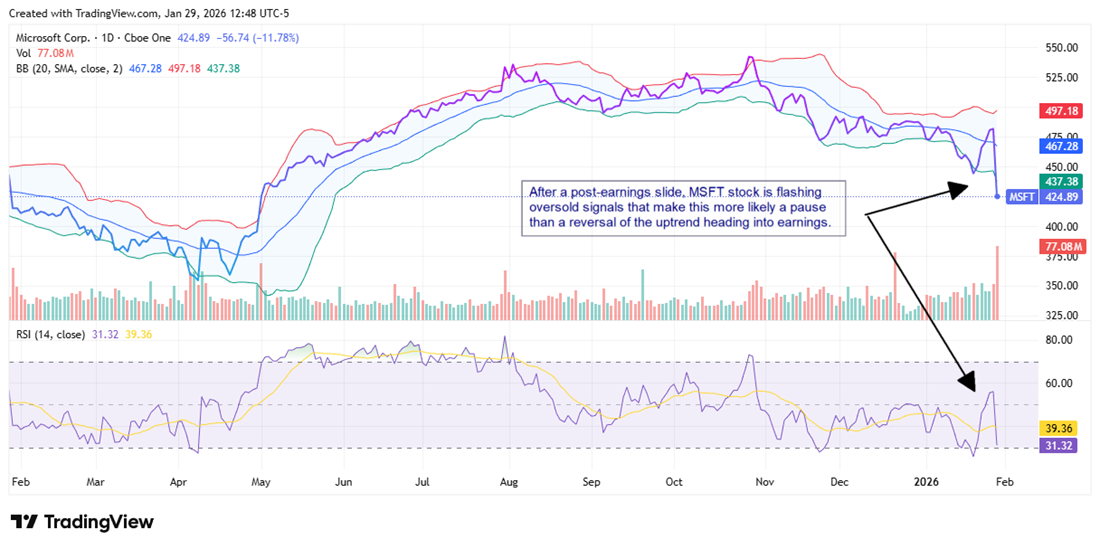 That means that Microsoft may still have further to fall. However, MSFT stock was up approximately 10% in the five trading days prior to earnings. The sell-off has erased those gains and pushed the stock down to levels not seen since May 2025. That’s where the opportunity may lie. Microsoft stock is now flashing strong oversold signals. That supports the idea that the price action following the report is more of a pause to the recovery than a reversal. Read this article online › Recommended Stories 
Did you like this article?  
|
Comments
Post a Comment